
Alta Forma presents: ‘Between a Rock and a Soft Place’, curated by Manon van Kouswijk.
9 - 30 October, 2026
Alta Forma is delighted to present, ‘Between a Rock and a Soft Place’, curated by Manon van Kouswijk.
Wearing jewellery can be considered as part of a layering; a geology of body, skin, dress, ornament. An accumulation of material, place and time. There’s an interesting dichotomy between the fragility of the human body and the toughness of jewellery materials like metals and stones that will inevitably outlive us. This is fertile ground for contemporary jewellers to work with, work around, work against, embrace, reject, rejig, rethink. ‘Between a Rock and a Soft Place’ applies a multitude of gestures to a broad range of materials, images and objects producing works that carry meaning beyond the decorative. Featuring: Laila Marie Costa, Helena Johansson Lindell, Suska Mackert, Despo Sophocleus, Mirei Takeuchi, Charlotte van de Velde, Manon van Kouswijk, Jamila Wallentin.
Exhibition dates: 9-30 October, with special additional hours:
Sunday 25 October (12-4) and Wednesday 28 October (12-5).
Opening celebration: Sat 10 Oct 2-4pm.
‘Between a Rock and a Soft Place’ is presented as part of Radiant Pavilion
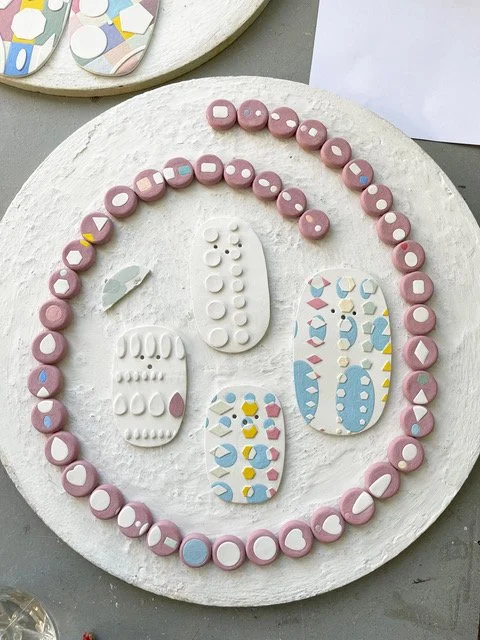
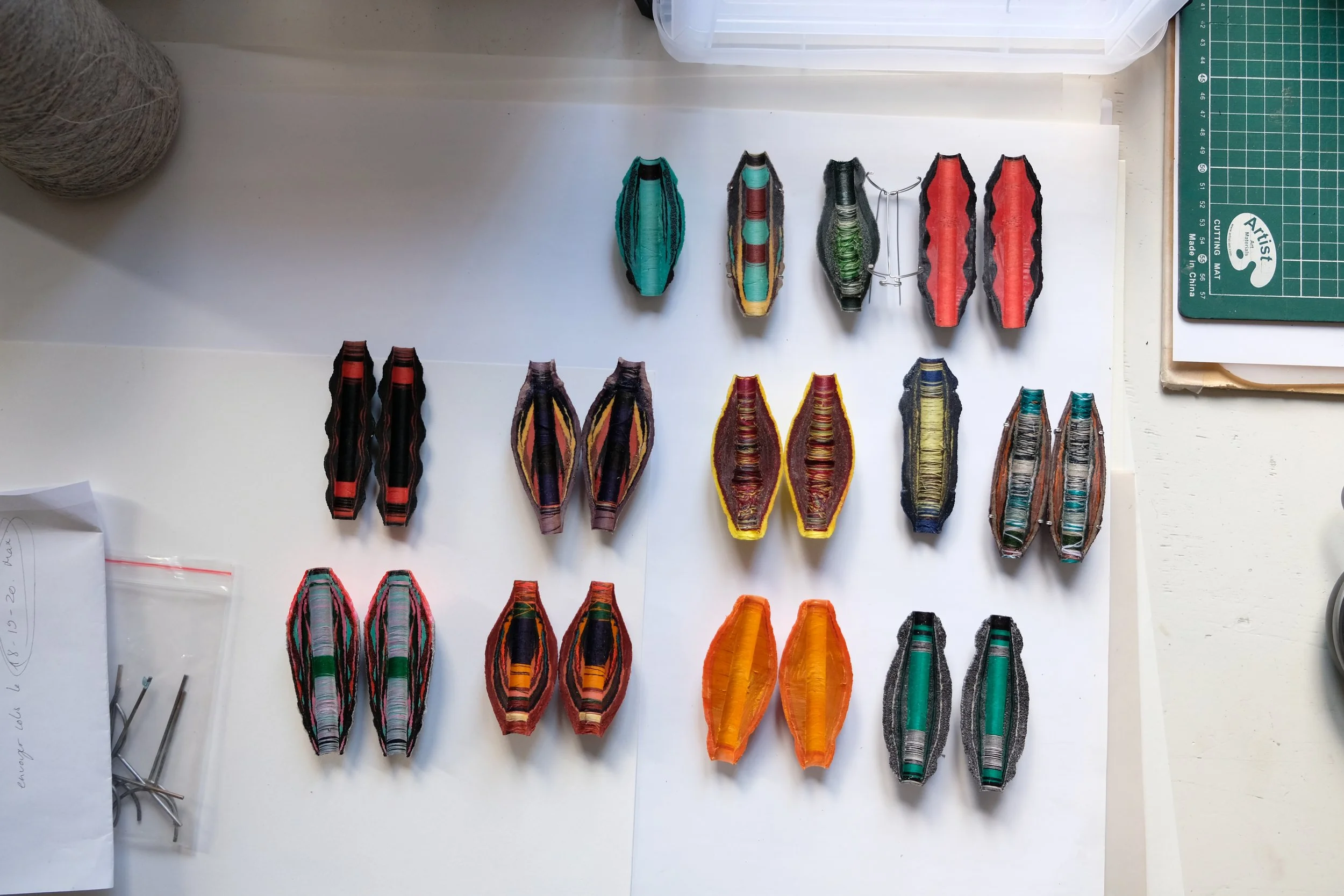
Artwork details: Left: studio view Jamila Wallentin, 'Incisions' brooches in progress; right: studio view works in progrss Manon van Kouswijk. Images courtesy of the artists. Manon van Kouswijk is represented by Funaki, Naarm/Melbourne.
About the artists:
Laila Marie Costa is a visual artist who predominantly works with contemporary jewellery, though performance, installation and video are modes of engagement too (when engaging). The rings from the Micro Monuments voor de Antverpians series were made during an artist in residence at DIVA Diamond Museum, Antwerp, and exhibited there in 2025. Costa obtained a Master in Visual Art (Contemporary Jewellery Design) from PXL_MAD, Hasselt, Belgium, in 2023, a Postgraduate Diploma for the Victorian College of the Arts in 2003 and a Bachelor(ette) in Fine Arts at Royal Melbourne Institute of Technology, Melbourne in 1993. She has exhibited nationally and internationally in museums, galleries, project spaces and artist run initiatives. Costa was an Artist in Residence at DIVA Diamond Museum, Antwerp, in 2024, and completed an Emeritus Traineeship with Ralph Bakker, master jeweller, Rotterdam, Netherlands. In 2024 Costa returned to Naarm/Melbourne and is currently developing her Empire of Clean.
Born in Huskvarna, Sweden, Helena Johansson Lindell creates one-of-a-kind wearable works, utilizing material substances such as wood and plastic from found objects. Deconstructed, altered, and then reassembled, everyday cooking tools and children’s toys are transformed from their initial incarnation into playful but modernist adornments for the body. Minimal in aesthetic and configuration, each piece is turned on a lathe, rendering smooth, sensual, and brightly colored forms. Lindell studied Jewelry at the Konstfack University College of Arts, Crafts & Design in Stockholm, Sweden and earned a BA in Visual Art from Oslo National Academy of the Arts in Norway. Her work has been featured in solo and group exhibitions exhibited throughout Europe; in France, Holland, Norway, Germany, Finland, Austria, Belgium, and the UK. She is the recipient of numerous grant and awards, including the 2014 Swedish Arts Grant (international cultural exchange).
Suska Mackert was born in Munich Germany where she studied Philosophy, Drama and Art History at the Ludwig Maximilians University in 1988-’89. From 1989-1992 she learnt goldsmithing in Neugablonz at the Staatliche Berufsfachschule für Glas und Schmuck. She completed a Bachelors at the Gerrit Rietveld Academy in Amsterdam in 1998 and a Masters at the Sandberg Institute in Amsterdam in 2000. Mackert’s practice is an emphatic reflection on the open identity of the jewellery object. Her way of work, with a great love of detail reflects its crafted nature. Its making requires great skill, precision and patience - carefully holding something very small, polishing, weaving, cutting, carving. Her gesture is both conceptual and performative. The identity of the object cannot be fixed, and the object itself is a nodal point in an expanding network of social relations, work, gestures, economies. She demonstrates the pervasiveness of jewellery objects, its presence in the most unexpected places.
Despo Sophocleous received a BFA in Jewellery Design and Metalsmithing from NSCAD University in 2008. During this time she also participated in a one year study exchange at Pforzheim University. Upon graduation, she returned to Germany to pursue graduate studies at the Munich Academy of Fine Arts under Otto Künzli from 2009 to 2015. Her work has been exhibited nationally and internationally, and is included in the collections of Die Neue Sammlung, Munich, and the CODA Museum, the Netherlands. She has received several awards and support for her work including the Lieutenant Governor’s Award for Artistic Achievement from the Nova Scotia Talent Trust, the DAAD scholarship for graduate studies and the Herbert Hofmann Award.
Born in Porz-Wahn, Germany, in 1969, Mirei Takeuchi studied product design at Kyoritsu Joshi University in Tokyo from 1987 to 1991. She then worked as an interior designer until 1995, when she became an assistant at the same university. In 2000, back in Germany as a visiting student at the University of Applied Sciences and Arts in Hidesheim for a year, she decided to continue her studies in jewelry at the Munich Academy of Fine Arts under Otto Kunzli. She obtained her Master’s degree in 2010, and her work won the Bavarian National Award and the prestigious Herbert-Hofman Prize in 2011. Her work can be found in numerous private and public collections, including The Victoria and Albert Museum, London, The Sammlung Danner-Stiftung Pinakothek der Moderne, Munich, Kunstmuseum Den Haag, The Hague, Munchner Stadtmuseum, Munich, and Museum Kolumba, Cologne.
Charlotte Van de Velde (1988, BE) is a visual and jewellery artist based in Brussels. Fascinated by the endless variations of our material culture, her practice begins with the collecting of objects and pieces of jewellery. She is drawn not only to conventional notions of beauty and authenticity, but equally to imperfection, wear, quirkiness and imitation. Using photography and scanning techniques, she highlights subtle qualities of her finds that might otherwise go unnoticed. Close-up images of imitation gemstones, for instance, reveal curious production flaws or traces of use.
Charlotte Van de Velde studied Art History at Ghent University, graduating in 2010, before completing a Master’s degree in Jewellery Design and Silversmithing at Sint Lucas Antwerp in 2015. Her work has been exhibited at Brussels Jewellery Week, Valerie Traan Gallery (Antwerpen), Design September (Brussels), Talente (Munich), Sieraad (Amsterdam), Obsessed! Jewellery FesPval (Amsterdam) as well as at the DIVA Museum in Antwerp, where she was an artist-in-residence in 2022.
Manon van Kouswijk is a Dutch artist who has lived and worked in Australia since 2010. After formal training as a goldsmith, Manon studied jewellery at the Gerrit Rietveld Academy in Amsterdam, where she graduated in 1995 and later on worked as Head of the Jewellery Department from 2007-2010. The word ‘findings’ has multiple meanings. It is commonly used to describe the outcome of research, investigation or a discovery however it also refers to the small tools and various materials used by an artisan: a jeweller’s findings. This duality is very accurate in describing Manon’s position as an artist within the field of contemporary jewellery. She views her practice as an ongoing exploration of the potential for jewellery to happen. Her findings are mediated through the making of objects, through photography, drawing, artist books and exhibition making. Her work is exhibited in galleries and museums and is part of public and private collections worldwide.
Born in 1991 in the Vosges, France, Jamila Wallentin lives and works in Paris. She originally trained in textile practices before studying archaeology and art history, later completing a degree in contemporary jewellery at the Haute École des Arts du Rhin and at the Akademie der Bildenden Künste in Nuremberg. She received the thesis prize for Zusammenhänge, a series of narratives exploring the storytelling potential of objects beyond their materiality and the role of encounters in her artistic practice. In 2020, alongside her artistic research, she completed a Master’s degree in contemporary art criticism and writing. Since 2024, she has been based in Paris, where she runs her studio and teaches in the Bachelor in Jewellery Arts and Techniques programme at École Boulle. Her work, developed through research residencies, has been presented in solo exhibitions including Porteuses-Porteurs(La Grande Boutique) and Une histoire, une prière, un espoir (Musée du Feutre), as well as in group exhibitions across France, Belgium and Germany, such as Design Without Borders (Budapest), Résonances (Strasbourg), MK&G Messe (Hamburg), Collectible (Brussels) and Talente (Munich).